

What We Can Learn from the World's Best in Work-Life Balance
It’s very common in Indian workplaces to call meetings as the workday is about to end. I have worked across the country in different institutions and can’t recall any that didn’t have a culture of holding meetings late in the day and extending them well after work hours. This isn’t even unusual for many people, who believe in authority or treat them as God. I have seen very few people protest against extending meetings or calling them after hours. It’s so normalised it’s simply considered part of the Indian work culture.
My experience is from academia, so I’ll share my perspective from the academic “industry” of knowledge production. Some organisations even believe that if you work beyond your scheduled hours, you are more efficient and hardworking. This creates the notion that the employee is loyal and considers the workplace their second home. You shouldn’t be surprised to find that these people are the ones who get promoted easily and receive monetary compensation. I remember those days when a renowned private university wasn’t at all ashamed to call its faculty members in on Sundays for “important duties.” They offered compensation, but guess what? You could take a “comp-off” for that day during the semester, but you couldn’t miss any of your classes. So, you had to find someone else to take your classes for you. Basically, the whole process of taking leave was so cumbersome that you would just drop the idea of taking it.
The Toll on Faculty and Mental Peace
The system increases your teaching hours for a particular day. After you return from leave, you would have to take classes for those who covered for you. This could mean teaching four or five lectures in a single day. Then, meetings with senior authorities would be a trauma for many faculty members. Can you imagine teaching under surveillance, as if you aren’t a teacher but a performer? Someone sitting in their cubicle, keeping an eye on your lectures, even though they don’t know anything about your discipline. Of course, work-life imbalance is worsened by the six-day work week. Only public universities, premier organisations, and a few private universities allow for a five-day work; most universities operate on six days or with a half-day on Saturdays.
The knowledge production Universities, I would rather say “factories” should be creating a knowledge base on experiential learning and look toward countries that maintain a healthy work-life balance. Romanticising the workaholic cultures of countries like the USA, Germany, or Japan is not a good idea. Japan, for example, has been discussing the “Karoshi” syndrome, or “death by overwork,” since the 1980s. Although the Japanese are known for their hard work, their poor work-life balance has contributed to family conflicts. However, these countries still maintain strong labour laws unlike us.
Best Work-life Balance Country and its Work Culture
Now, I am in a country that is number one in terms of work-life balance. This country is on a completely different trajectory. For me, it was a shock to see how relaxed people are here. Although I am not working here, I am interacting with friends and other acquaintances who share their workplace experiences. The country focuses on output rather than on the number of hours you spend on a project—a simple rule of quality over quantity.
Moreover, workplaces here offer different categories of leave, and some big companies even monitor whether you are taking your leave or not. The idea is that you shouldn’t be under too much stress. From sick leaves to casual leaves, all are your right. If you ask to apply for casual leave, no one questions your reason. That’s what “casual leave” means, right? But back in India, if I applied for my own leave, I was expected to explain the reason. And long leaves? Forget about it.
Another difference is the trust level between employer and employee. If I applied for sick leave for more than three days in India, I had to submit evidence. You can judge who is responsible for this lack of trust. Here, no such requirement exists (with certain genuine conditions). Some big organisations even give you the option of a career break (without pay) for three months to one year, and you can always come back or maybe not. I know a few universities in India offer a semester break (without pay) but even applying for that requires a good rapport with the management, which is hard for many and easy for a select few. I am not as familiar with corporate experiences, but I know a few of my friends struggle to get leave approved and are highly dependent on their immediate managers.
The Broader Impact and The Way Forward
Although a direct comparison between these two countries may not be entirely fair—one being a very small country and the other being the world’s largest democracy—it’s not impossible for India to achieve at least 30-40% of what this country offers. If leave policies exist, people should be allowed to use them, because it’s their earned right and they deserve it. I know a few organisations are lenient with their policies, but their number is very small.
Work-life balance is truly important. Once you start spending more time at work, you become more involved with professional people, and they start playing an important role in your life, even though they shouldn’t. Your family members might start losing interest in you, and in the long run, this can create a disassociation from your own family. Professional environments in India are popularly full of toxicity, and most of the colleagues are unsupportive. This gradually starts playing on your mind, and ultimately, your mental peace is gone.
I have also met people who have drawn good boundaries between their personal and professional lives, but this often requires certain preconditions like job security, experience, and a good job market to switch jobs easily. These, however, are also significant concerns in India.
Remembering the Legacy of an Educated Leader of India
Geeta Kashyap
January 07, 2025
Indians are mourning the death of former Prime Minister (PM) Dr Manmohan Singh. I believe the only PM of India who got more respect after death than he did while alive. In a foreign land, he was a renowned economist and was among the well-respected leaders. He saved the Indian economy on many occasions. His remarkable budget of 1991-1992 introducing Liberalisation, Privatisation and Globalisation (LPG) opened the Indian market for better business, and in 2009, during the economic recession, he again saved the Indian economy with his rapid actions.
I was pursuing my undergraduate journalism degree (2004) when he became the Prime Minister of the country. I have very good memories of the policies and the measures he took to improve the economy of the country. The postgraduate degree in Journalism mandated you to read news regularly, and as part of the degree, debates and discussions were a common scenario. Here, I am writing what I can recall of him as a leader of the country from 2004-2014. Well, in media he was termed as ‘Maun (silent)-mohan’ Singh. He was generally silent, but he spoke during the press conferences and faced the media very well.
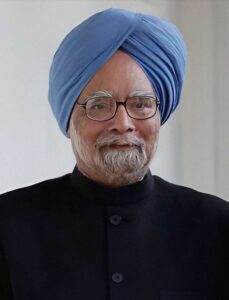
Dr Singh was also named as a puppet of Sonia Gandhi, who is just following the orders of the then Congress President (Sonia). In a way, it can also be true because Manmohan Singh does not come from a political lineage. He was primarily an educator and economist. He was also a reluctant prime minister. After taking charge, he took many steps to keep the country on track economically. He earned his D. Phil from Nuffield College, University of Oxford, and researched on the topic ‘India’s Export Trends and Prospects for Self-Sustained Growth’. Throughout his education, he held the first position from Matriculation to M.A. (Economics). He studied at Panjab University from Matriculation to M.A. Economics. In 1957, he completed his Economics Tripos- an undergraduate three-year degree programme in Economics with First Class honours from the University of Cambridge. His educational background was not just the degrees he earned, but there is a long list of awards, prizes, and honorary degrees he earned during his lifetime.
How I remember Dr Singh and India during his leadership is listed in the following points:
- During his regime Mahatma Gandhi Rural Employment Guarantee Act (MGNREGA) was launched which provided labour jobs to the rural population, in which labourers were given work such as digging wells, irrigation related work, sanitation etc. that ensured 100 days of wage based work to the rural populations focusing on the poor and marginalised sections. It is a livelihood security scheme promoting women’s participation. The scheme was appreciated for its initiative for rural development; however, many scams and the inappropriateness of funds are alleged at the grassroots level in recent years.
- In his regime, India got the Right to Information (RTI) Act that made the government more accountable towards the public. The Act came into effect on October 12, 2005, and while working in Hindustan Times from 2007-2009, I witnessed RTI-based news stories flowing in newspapers. Our bureau chief used to file many RTIs, and based on the information received, he did many front-page stories. This act was considered a weapon for the media. By the way, this law only helped Arvind Kejriwal to network and further start his political career. Kejriwal was a well-known RTI activist.
- In the second regime, his government introduced the Right to Education, 2009, that paved the way for mandatory primary education of children of 6-14 years under Article 21 (Article 21 A). There were many other policies promoting primary education among children, such as the Mid-day meal scheme. A leader who struggled himself to get an education can take such steps for his public.
- His press conferences were a regular event. We, as journalism students, used to conduct mock press conferences with the PM in the panel and media personnel asking questions as part of the activity. We learnt how to question the regime, and while working in media, questioning the Chief Minister or any other authority was never a hesitation. It was also not an ego issue back then, and still, you are the nationalist, not given the tag of traitor.
- There was regularity in the pay commission reports. In the seventh Pay Commission Report, the salaries of government employees jumped, and many important decisions were taken.
There is a list of scams as well during his regime, which failed the UPA government. The coalition government has its internal fragility, and the UPA succumbed to it and died after the 2014 elections.
- 2G spectrum scam- 2008
- Satyam scam- 2009
- CWG scam- 2010
- Cash-for-vote scam- 2011
- Adarsh scam- 2012
- IPL scam- 2013
The policies and good initiatives by the Dr Singh government were overshadowed by the scams. Also, the good initiatives by the UPA government are not something extraordinary, but it is quite normal for any government to introduce welfare schemes for the public. These events today look extraordinary for various reasons. There seems to be no one in the current regime who cares for middle-class and poor people. The media is pushing the government propaganda. The RTIs are not getting responses, or are delayed, or vaguely responded to.
When Dr Singh was PM and introduced so many schemes and policies media questioned him, criticised him, and he openly faced all the questions. But today’s media is biased, corrupt, and propagandist in its information dissemination, which is making Dr Singh more special. If you keep the Congress party and Dr Singh separate, then you can understand his vision. As he said, “History will be kinder to me than the contemporary media”, he was very much right. Manmohan Singh was also not so popular among the masses because to understand him, people have to read and understand, and probably the public is happier with jumlas and big fake promises.
May his soul Rest in Peace!
References:
https://www.visvabharati.ac.in/files/6340200114_Manmohan.pdf
https://nrega.nic.in/MGNREGA_new/Nrega_home.aspx
https://www.indiatoday.in/india/photo/upa-govt-9-years-9-scams-sonia-manmohan-369868-2013-05-22/7

The pandemic may knock out small newspapers in the Indian regional language news market
Co-Written by Geeta Kashyap & Harikrishnan Bhaskaran 03/06/2020
‘Tusi ki karoge je Rozana Spokesman nu band kar den di naubat aa jaye’ (What will you do if condition arises to close Rozana Spokesman), was an unusual appeal as a banner head appeared in Rozana Spokesman, a Punjabi newspaper published in the Indian state of Punjab on 10th May. In its 15 years of publication, this is the first time it published such an appeal to its readers. While the pandemic and the drying up of advertising revenue is causing unprecedented layoffs and shut downs across Indian media, regional language newspapers like Rozana Spokesman, are particularly staring at an existential question.
This article highlights the challenges of local newspapers and what they faced during pandemic.
Most Tiger Deaths In Madhya Pradesh, Maharashtra Over 8 Years
By Harikrishnan Bhaskaran & Geeta Kashyap| 17 Mar, 2018
Dharamshala, Himachal Pradesh: Tiger deaths in central Indian states over the last eight years, especially Maharashtra and Madhya Pradesh, could mean a setback for India’s tiger conservation efforts.
Between 2009 and 2017, 631 tigers were reported dead in India, according to Tigernet, the tiger mortality database maintained by the National Tiger Conservation Agency (NTCA).
Among these, the highest numbers–133 deaths (21.1%)–have been recorded in Madhya Pradesh, which has 13.8% of the country’s total tiger population of 2,226.
This story was published in Indiaspend- a data journalism initiative.
Wildlife Road Kills On The Rise in India, Shows Official Data
According to official data released by the Ministry of Environment, Forests and Climate Change in India, at least 10 tigers and 36 Asian elephants were killed by speeding vehicles or trains in the country during the three year period from 2014. These figures raise serious concerns as the wild population of tigers and elephants in India are very important for the sustenance of these species worldwide. This is my old post from 2018. Please click to read more.
Leave a Reply